
Exploring Depth in Concurrent Markets: Back-Lay Adjustments in Football and Racing Overlaps on Peer Exchanges
Market participants track liquidity layers across betting exchanges where football matches and horse racing events create overlapping trading windows that allow position switches from back to lay or the reverse. Data from July 2026 shows increased activity during these periods as traders monitor depth pools that form when live odds respond to in-play developments in both sports simultaneously. Observers note that volume often clusters at specific price points where one market's liquidity supports adjustments in the other without requiring large order sizes to move the line.
Mapping Liquidity Layers Across Dual Windows
Exchanges display order books that reveal layered bids and offers in football and racing markets at the same time, and researchers have documented how these layers interact when a Premier League fixture runs parallel to evening race meetings. According to figures released by the Victorian Commission for Gambling and Liquor Regulation, combined handle across such concurrent events rose steadily through the first half of 2026, with peak overlap windows occurring between 7pm and 9pm local time on Saturdays. Traders examine the available volume at each price increment because shallow layers in one sport can signal an entry point for reversing exposure in the other once momentum indicators align.
Depth charts update continuously during these windows, and analysts point out that a sudden fill on a large back order in football often precedes similar movements in related racing markets due to shared participant pools. Those who monitor multiple platforms observe that peer-to-peer matching engines route unmatched portions of orders into secondary layers that become visible only after initial volume clears. This process creates brief intervals where a position switch becomes executable at tighter spreads than would occur in isolated markets.
Timing Switches During Overlap Periods
Back-lay transitions require precise timing because liquidity in racing thins quickly after the final declaration of runners while football markets maintain deeper books through added time. Studies from the Australian Gambling Research Centre indicate that successful position flips occur most frequently in the minutes immediately following a goal or a late non-runner announcement, when fresh orders repopulate the book and create temporary imbalances. Market depth data shows that these moments allow participants to move from a back position in one sport to a lay position in the other without crossing wide spreads that erode margins.
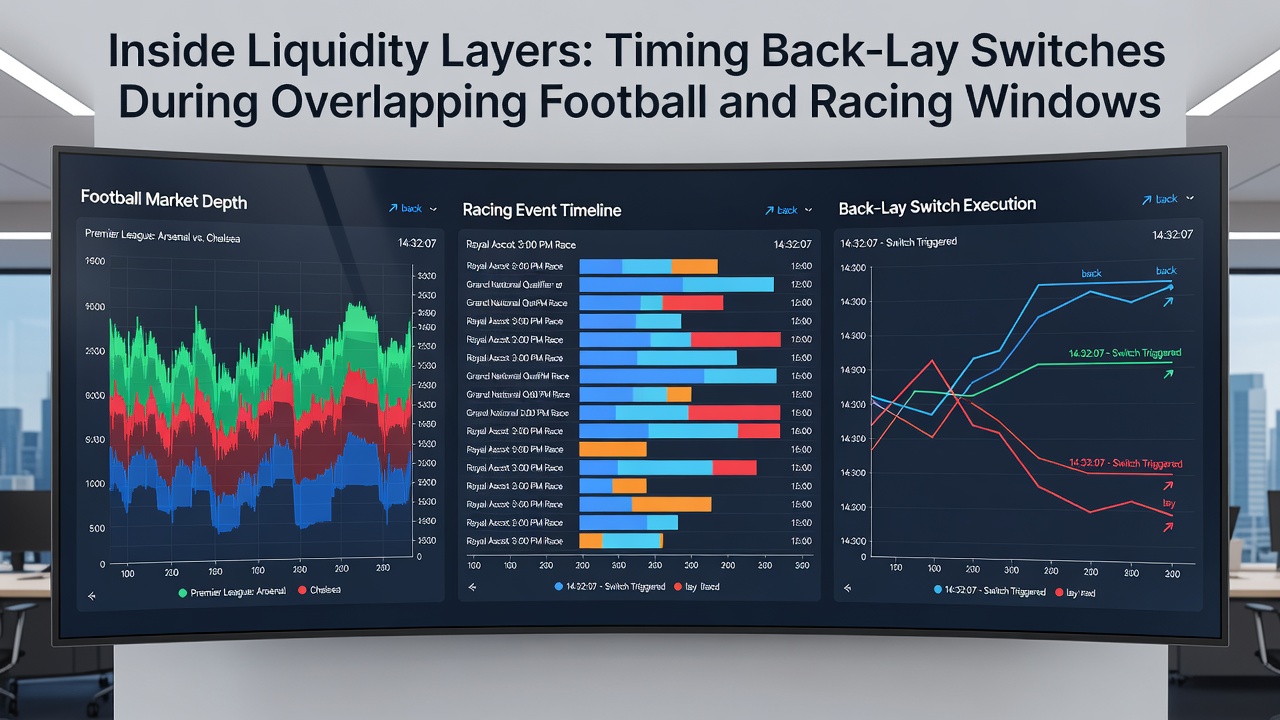
Order flow analysis reveals that volume clusters form at key price levels where both markets share correlated liquidity providers, and these clusters expand when external news such as team line-up changes or track conditions updates reach the platforms. Participants who follow these patterns often wait for confirmation of a fill in the primary market before executing the switch in the secondary one, thereby reducing the risk of partial execution that leaves residual exposure. Data from the same July 2026 period demonstrates that average execution times for such layered switches shortened as platform matching algorithms improved cross-market visibility.
Volume Patterns and Position Reversals
Peer platforms record surges in matched volume when football stoppage time coincides with the final stages of a race card, and exchange operators publish aggregated statistics that highlight these synchronized spikes. Research published by the European Gaming and Betting Association tracks how these surges expose layered opportunities because the additional liquidity allows larger position sizes to be reversed without slippage. Traders review historical depth profiles to identify recurring entry windows that appear when both markets experience parallel momentum shifts, such as a late equalizer in football and a photo-finish result in racing.
Those monitoring real-time feeds note that liquidity ripples travel between the two sports through shared user accounts that hold positions in multiple events, and algorithms now detect these connections faster than manual observation alone. Figures reveal that reversal success rates improve when switches are executed within thirty seconds of a confirmed volume cluster rather than after the initial surge dissipates. Platform records from mid-2026 confirm that the majority of layered trades during overlap windows involved at least one football market and one thoroughbred race, reflecting the dominant scheduling patterns on weekends.
Conclusion
Overlapping football and racing windows on peer platforms continue to generate layered liquidity that supports timed back-lay switches, with data from July 2026 underscoring the importance of monitoring concurrent depth and volume clusters. Market participants rely on order flow visibility and historical patterns to identify executable intervals, while platform operators publish statistics that document the frequency and scale of these adjustments. Continued refinement of matching engines and cross-market analytics is expected to maintain these dynamics as central features of exchange-based trading in both sports.